Material Evidence: Su‑style Brick Carvings Art Exhibition in the Mid‑to‑Late Qing Dynasty
As a material carrier of Confucian culture, ancient Chinese architecture is highly consistent with the nation’s mindset, behavior, aesthetic orientation, values, and aspirations for the future. Likewise, architectural ornamentation, beyond its aesthetic appeal, embodies intricate social and historical contexts and carries rich cultural connotations.
Suzhou’s literati gardens, as representatives of Chinese gardens, encapsulate the natural environment, traditional philosophy, cultural heritage, and local customs of the Jiangnan region. They reflect the taste and spirit of Jiangnan literati life and bear distinct epochal features of social culture, aesthetic fashion, and ritual institutions. Su‑style brick carvings embody the same aesthetic and ethical ideals and present the beauty of ritual order. Regardless of pattern or refinement, they follow a basic format characterized by unity and standardization.
Mr. Liang Sicheng stated that ancient Chinese architecture “usually adopts a strictly symmetrical layout… The most important element is the establishment of the central axis. All structures develop along this axis, with arrangements ordered symmetrically to the left and right.” The central axis of architectural space reflects the Confucian emphasis on “upholding the center,” and the hierarchical order thus established forms a key part of the Confucian “ritual system.”
Ancient Chinese architecture strictly followed ritual principles in layout. The imperial cities, palace complexes, and internal halls of successive dynasties represent the most typical ritual spaces, albeit on a grand scale.
Private residences, though smaller, applied the same principles: they featured a central axis and bilateral symmetry, with the main hall— the most important structure—positioned centrally, facing south, and built to the largest scale. Beyond mere central symmetry, the scale, specifications, and sequence of interior spaces and buildings also complied with ritual norms, creating hierarchy to match functional needs. Architectural space and its configuration formed a clear isomorphism with the concept of “ritual,” and the ordering of space served to educate people in ritual propriety. In ancestral halls, gardens, and residences alike, decorations, inscribed plaques, and couplets carried such symbolic and didactic meanings.
The overall layout, scale, and circulation of architecture are not easily perceived; their underlying concepts and institutions are not immediately visible. By contrast, the ritual function of architectural ornamentation is more intuitive and diverse. Stone carvings, brick‑carved gate towers, inscribed plaques, inscribed stone strips, and wood carvings comprehensively interpret the idea of “ritual.” Daily life within such spaces naturally integrated ethical norms and ritual practice, fostering harmony between hosts and guests, order between elders and juniors, and proper decorum for men and women. The “ritual” embedded in space was repeatedly emphasized, practiced, and reinforced over time, gradually internalized as conscious conduct by those who lived there.
As a vital component of architectural decoration, Su‑style brick‑carved gate towers possess aesthetic value in form and space while satisfying the owner’s taste. Spiritually, they convey cultural values through distinct, allegorical imagery, fulfilling the social function of Confucian moral education.
Most Suzhou brick‑carved gate towers stand centrally in passageways between two‑row buildings running north–south, facing north. This northern orientation distinguishes them from those in other regions. Besides enriching spatial layers and providing fire and theft protection, gate towers regulated ritual conduct. In particular, the brick‑carved gate tower behind the main hall separated the outer and inner quarters: the outer zone centered on the main hall for ceremonies and guest reception, and the inner zone centered on the upper hall for family living, keeping the two distinct and undisturbed. Gate towers and passages defined daily circulation and activity zones, constantly reminding residents to observe their status and ritual norms.
Brick carvings of the mid‑Qing period notably depict plump figures, mostly elderly, with dignified postures in walking, greeting, sitting, and reclining, all in accordance with ritual rules. Like other art forms of a prosperous age, they feature full forms and strong lines, reflecting political stability, social harmony, and prosperous, peaceful life.
Su‑style brick‑carved gate towers cover rich themes and deliver Confucian education directly through vivid, accessible images and texts. Their two major media are inscribed panels and carved patterns.
Common inscriptions include “Everlasting Solidarity,” “Great Virtue Bears Blessings,” “Thrift Ensures Endurance,” and “Firmness and Rectitude.” Household members encountered these moral maxims daily. Positioned at the center of the gate tower, these inscriptions allowed their educational meaning to be inherited consciously through cultural identity.
With the passage of a hundred years, numerous ancient brick‑carved gate towers have gradually disappeared. As times evolve, brick carvings are no longer widely used as decorations in modern architecture, and changes in residential architectural styles have distanced brick carvings from contemporary life.
Though centuries old, the surviving ancient brick carvings still possess an indelible beauty and have evolved into pure works of art.
Material objects are fragile against the erosion of time; they may wear away, vanish, be destroyed by human hands or by fate. In short, destruction comes relatively easily. Yet fine traditional art must be preserved and inherited. What we inherit is not merely a craft, but a symbol of spirit and culture.
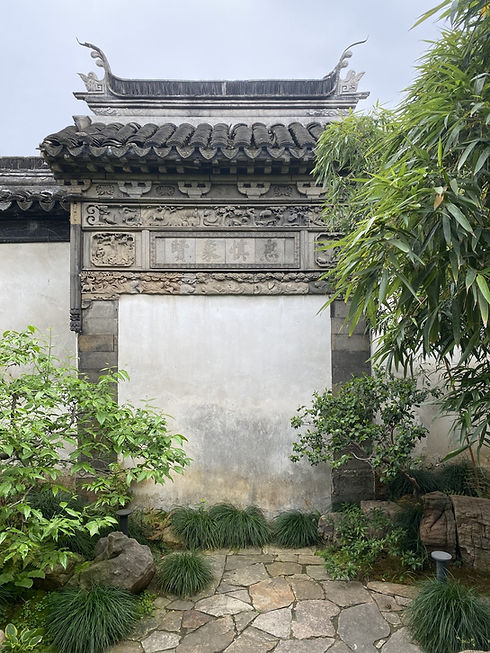
The brick‑carved gateway of the former residence of Wang Ao, a distinguished statesman and litterateur of the Ming Dynasty, features a hip‑and‑gable roof covered with grey tiles, with mythical beast ornaments at both ends of the roof ridge. The horizontal tablet in the center of the lintel is inscribed with “Loyalty, Prudence and Emulation of Worthy Predecessors”, surrounded by exquisite relief carvings.
Source of exhibition images:
Suzhou Brick Carving Museum
Exhibition link:
https://metasteps.com/viewer/5e4568ce-0130-40e8-a703-f45a9967afe4
Special note:
This version is a screen - recorded file with automatic playback by the software. When played on the metasteps platform, the name and description of each work will be displayed.
Note: The video takes about 5 seconds to load.