Suzhou Brick Carving Museum
In my brick carving project, my focus was not merely on the works themselves, but on how museums organize and present art history through classification and exhibition. By sorting out the relationship between brick carving themes and their spatial functions, I gradually realized that classification itself is an act of interpretation, which influences how we understand the social significance of these works. This project prompted me to reflect on the institutional level: art history is not a natural outcome of how works exist in their own right, but rather knowledge that is structured and transmitted within museum and archival systems.
Photographed on-site at Jingdezhen Imperial Kiln Museum>

Physical Evidence of History: Multi-Dimensional Interpretation and Contemporary Value of Suzhou-style Brick Carvings in the Mid-to-Late Qing Dynasty
As a material carrier of Confucian culture, ancient Chinese architecture is highly consistent with the thinking patterns, behavioral norms, aesthetic preferences, value recognition, and future expectations of the entire nation. Similarly, architectural decoration, apart from its aesthetic pleasure function, also contains a complex social and historical background and carries rich cultural connotations.
We often say that Suzhou scholar gardens, as representatives of Chinese gardens, are carriers of the natural environment, traditional philosophy, cultural traditions, and regional customs of the Jiangnan region, revealing the life interests and spirit of Jiangnan scholars, and embodying distinct characteristics of the times in terms of social culture, aesthetic trends, and ritual systems. Suzhou-style brick carvings also contain the same aesthetic and ethical ideas, presenting the beauty of ritual systems. Regardless of the pattern style or the degree of carving fineness, they all have a basic format, with uniformity and standardization.
Mr. Liang Sicheng said that ancient Chinese architecture "usually adopts a layout of left-right symmetry to achieve a balanced and symmetrical arrangement... The most important thing is the establishment of the main central axis. All organizations develop based on the central axis, and their deployment order is divided into left and right." The central axis of the architectural space reflects the ancient Confucian understanding of the concept of "valuing the center", and the architectural hierarchy order established thereby constitutes an important part of the Confucian "ritual system".
Ancient Chinese architecture strictly followed the ritual system in its layout. The imperial cities, palace cities, and internal palace complexes of successive dynasties were the most typical ritual spaces, although their scale was extremely large. Private residences, although smaller in scale, also adhered to the same principle: not only having a central axis but also being symmetrical left and right, with the main hall in the center facing south and having the largest volume. Of course, it is not just a simple "central axis symmetry" relationship. The volume, specifications, and sequence of each block and each house within the building also need to conform to the norms of the "ritual system", forming differences and hierarchies to correspond to different functional requirements. The architectural space and configuration relationship form a clear isomorphic relationship with the "ritual system" concept. Through the construction of architectural space order, the educational function of "ritual" can be implemented. Whether it is a temple, a garden, or a residence, in the specific architectural space, various decorations, plaques, couplets, etc., all have such symbolic meanings and educational functions.
The overall layout, volume, and dynamic flow lines of a building are difficult for ordinary people to observe and understand. The concepts, systems, and ideas behind them are not directly visible. In comparison, the ritual functions of architectural decoration are more intuitive and diverse. For example, stone carvings, brick-carved gateways, inscribed plaques, stone tablets with inscriptions, and wood carvings can comprehensively interpret the concept of the "ritual system". Daily life unfolds in this environment, naturally integrating corresponding ethical norms and ritual practices, making guests and hosts courteous and harmonious, elders and juniors orderly, and men and women behaving appropriately. The "ritual" in the space is repeatedly emphasized, continuously trained, and constantly strengthened over time. People living in this environment gradually internalize it as a conscious behavioral norm without realizing it.
As an important part of architectural decoration, Suzhou-style brick-carved gateways, in addition to their aesthetic appreciation value in terms of space and form, satisfying the owner's aesthetic needs, also convey cultural values and have the social function of Confucian education at the spiritual level through decorative images with distinct themes and profound implications. Most of the brick-carved gateways in Suzhou stand at the passage between two buildings running from north to south, centrally located and facing north, which is a significant difference from brick-carved gateways in other regions. While enriching the spatial hierarchy and providing fire and theft prevention, the gateways also have the function of regulating etiquette. Especially the brick-carved gateway behind the main hall serves as the boundary between the outer and inner residences, forming the outer residence centered on the main hall and the inner residence centered on the floor hall. The former is a place for various ceremonies and receiving guests, while the latter is where the owner and his family live. The two areas are clearly separated and do not interfere with each other. The daily movement lines and activity areas within the courtyard are defined by the gatehouse and passageways, constantly reminding the people living there to be mindful of their status and adhere to etiquette norms, and to be cautious in their words and deeds.
In the brick carvings of the mid-Qing Dynasty, it is interesting to note that the figures are often depicted as plump, mostly elderly figures. Their postures when walking, welcoming, sitting, or lying down are rather dignified, following the norms of the ritual system. Like other artworks, during prosperous times, the figures are depicted with full forms and strong lines, reflecting the true social conditions of political stability and prosperity, as well as a comfortable and affluent life.
The subjects of Suzhou-style brick-carved gatehouses are very rich, and the Confucian teachings are the most direct. They are both illustrated and accompanied by text, making them vivid and easy to understand. The two main carriers are brick-carved inscriptions and brick-carved patterns.
Common inscriptions on brick-carved gatehouses include "Only with Permanence and Stability", "Virtue Brings Blessings", "Frugality Ensures Longevity", and "Uprightness and Moderation". The owner and his family would see these maxims and warnings every time they left their home. The inscriptions are placed in the center of the Suzhou-style brick-carved gatehouse, and their educational significance becomes a conscious inheritance under cultural identity.
The appreciation and classification of Suzhou brick carvings can be divided into two major categories: Patterns and Characters.
The Pattern Category includes six subcategories: Figures, Auspicious Birds and Beasts, Immortal Stones and Spiritual Plants, Auspicious Symbols, Scholar's Treasures, and Landscape Sketches.
The Character Category consists of three subcategories: Four-character Phrases, Two-character Phrases, and Others.
This report presents a systematic documentation of 34 selected artifacts from the Suzhou Brick Carving Museum, comprising 20 pictorial works and 13 textual specimens. Detailed illustrations and descriptions of these pieces are provided in the subsequent section.
Pattern Category
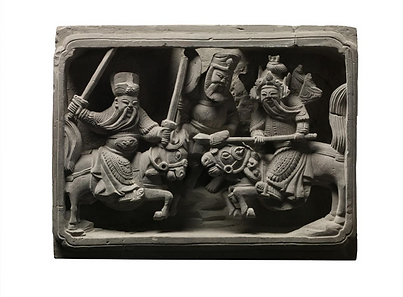
Romance of the Tang Dynasty: Prince Qin Spies on Baibi Pass at Night; Shubao Rescues the Emperor at Hongni Gully
Period
Mid-to-Late Qing Dynasty
Structure
Doudu (pocket panel)
Dimensions
39 cm × 31 cm × 9 cm
Image Source
Photographed on-site at the museum
Description
This scene is from Chapter 45 of Romance of the Tang Dynasty: "Prince Qin spies on Baibi Pass at night, and Shubao rescues the emperor at Hongni Gully." In the carving, Cheng Yaojin (holding a Xuanhua battle axe) is tied up at the camp gate watching the battle; Qin Shubao (fully armored, holding a spear) mounts his horse to rescue Prince Qin, swinging his twin maces at Yuchi Gong, who blocks with a spear—their martial arts skills are evenly matched.
The work extensively uses openwork, round carving, and hollow carving techniques to depict the battle scene within a limited space. The figures are full-bodied and vividly rendered, particularly in the details of facial expressions and costumes.

The Eight Immortals
Period
Mid-to-Late Qing Dynasty
Structure
Fang (beam panel)
Dimensions
65.5 cm × 28 cm × 9 cm
Image Source
Photographed on-site at the museum
Description
The Eight Immortals are eight Taoist immortals in ancient Chinese folklore: Tieguai Li, Han Zhongli, Zhang Guolao, He Xiangu, Lan Caihe, Lü Dongbin, Han Xiangzi, and Cao Guojiu. Their names in the Ming Dynasty novel The Eastern Journey (by Wu Yuantai) are identical to those passed down today. Each Immortal has one or two treasures (known as the "Hidden Eight Immortals" or "Eight Treasures"): Tieguai Li’s gourd, Han Zhongli’s palm-leaf fan, Zhang Guolao’s fish drum, He Xiangu’s lotus, Lan Caihe’s flower basket, Lü Dongbin’s sword, Han Xiangzi’s flute, and Cao Guojiu’s tablet.
Stories of the Eight Immortals are beloved by the public. To this day, the Eight Immortals and the "Hidden Eight Immortals" (as auspicious symbols) are widely used in traditional Chinese arts and crafts.
In the carving, ancient pagodas and pavilions are hidden among auspicious clouds and mountains, depicting the mist-shrouded abode of immortals. Cao Guojiu (holding a tablet) stands between a cliff and an old tree, his robes fluttering in the mountain breeze; Lan Caihe (with a flower basket beside him) leans against a wine jug, lying in a relaxed, half-asleep state with a naive, tipsy expression—creating a peaceful and vivid scene of prosperity and tranquility.

Scholar Figure
Period
Mid-to-Late Qing Dynasty
Structure
Doudu (pocket panel)
Dimensions
48 cm × 30 cm × 9.5 cm
Image Source
Photographed on-site at the museum
Description
"Scholar Figure" (Gao Shi Tu) is a common theme in Chinese painting—Ming Dynasty painters Tang Bohu and Qiu Ying created numerous works of this type. Such themes reflect the leisurely tastes of ancient literati and are widely seen in ancient paintings, porcelain, lacquerware, and carvings.
The carving depicts a literati (holding a folding fan, looking relaxed) leaning against an old pine tree in a mountain forest; a boy servant (holding a guqin, smiling) follows closely behind, waiting for his master’s order; another boy servant (on a rock, holding a fan to make tea) looks back at the master and servant. The background is decorated with pine, rocks, and lofty mountains. Using round and deep relief techniques, the old pine is vigorous, the figures are vivid, and the three figures echo each other—creating a strong sense of layered space.

A Phoenix Arrives as an Omen
Period
Mid-to-Late Qing Dynasty
Structure
Doudu (pocket panel)
Dimensions
44.5 cm × 33 cm × 9 cm
Image Source
Photographed on-site at the museum
Description
This phrase comes from The Book of Documents · Yiji: "When the music Xiao Shao was played nine times, a phoenix arrived." It refers to an auspicious omen in ancient times. Xiao Shao was a musical piece of the Shun period, and also a general term for beautiful celestial music.
The panel is richly composed: beneath an ancient paulownia tree and in front of a mountain pavilion, a colorful phoenix dances to the sound of the xiao (flute), raising its neck to sing. The phoenix’s song and the xiao’s melody harmonize like heavenly music. Below the pavilion is a stone platform, with overlapping peaks; ganoderma, scholar’s rocks, and slender bamboo are carved on the left and right sides, creating a lasting charm.

Pine and Crane for Longevity
Period
Mid-to-Late Qing Dynasty
Structure
Doudu (pocket panel)
Dimensions
52 cm × 31.5 cm × 8.5 cm
Image Source
Photographed on-site at the museum
Description
The crane is a symbol of longevity—elegant in temperament and ethereal in demeanor, embodying the aura of an immortal. When paired with a tall, vigorous ancient pine, it forms one of China’s traditional auspicious motifs, signifying "longevity and prolonged life."
In the carving, the towering pine stands sturdy and concise, with a compact composition. Adorned with mountain bamboo, ganoderma, and waterweeds, these elements are arranged in an orderly yet natural scatter, balancing density and space. The work integrates deep relief, openwork, and round carving techniques: the composition features overlapping layers of high and low elements, creating a harmonious sense of irregularity. The crane is depicted in dynamic poses—bending down to peck at food, then twisting its neck to look back. The entire carving is vivid and lifelike, blending stillness with movement to yield a charming and delightful artistic effect.

Ganoderma and Spiritual Plants
Period
Mid-to-Late Qing Dynasty
Structure
Doudu (pocket panel)
Dimensions
37 cm × 31 cm × 4 cm
Image Source
Photographed on-site at the museum
Description
Ganoderma is called the "auspicious herb" or "immortal herb"—ancient legends claim that eating it grants immortality, so it has long been regarded as an auspicious symbol, with far-reaching influence in literature, religion, architecture, and art.
The composition of the carving is dynamic: the scholar’s rock and ganoderma best showcase the craftsman’s skill—using the chisel like a brush, fine and delicate lines (hooks, turns, thickness, length) are used to depict form; chisel strokes create layered, undulating surfaces to show texture. The style is elegant and delicate; though the scene is simple, it creates an open, bright atmosphere.
.

Jade Hall and Prosperity
Period
Mid-to-Late Qing Dynasty
Structure
Doudu (pocket panel)
Dimensions
48 cm × 30 cm × 9.5 cm
Image Source
Photographed on-site at the museum
Description
In the Han Dynasty, imperial advisers worked in the Yutang Hall, so the Hanlin Academy (imperial academy) was often called "Yutang Office." Yang Xiong’s Jie Chao (Ridicule) states: "Having passed through the Golden Gate, I will soon enter the Jade Hall"—meaning promotion is imminent. "Prosperity" (Fugui) comes from The Analects · Yan Yuan: "I have heard that life and death are fate, and prosperity is determined by heaven," referring to wealth and high status. In Suzhou folk culture, the magnolia symbolizes the "Jade Hall," and the peony symbolizes "Prosperity"—combining these two flowers implies "Jade Hall and Prosperity," wishing for promotion and wealth.
The main elements of the carving are arranged diagonally, conveying dynamism and vitality. It is open and full, with a strong visual impact. The deep relief effect is prominent: magnolias at the top, peonies in the middle, and a cluster of mixed flowers at the bottom; three scholar’s rocks are placed in the lower right corner, natural and vivid. The scene feels familiar and approachable, embodying the designer’s love and attention to nature and life.
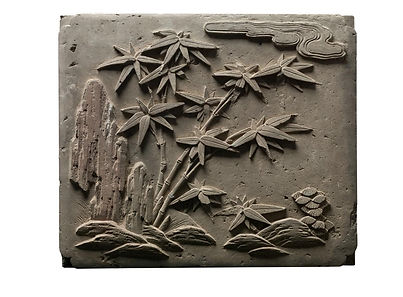
Bamboo and Rock
Period
Mid-to-Late Qing Dynasty
Structure
Doudu (pocket panel)
Dimensions
40 cm × 34 cm × 8 cm
Image Source
Photographed on-site at the museum
Description
The carving adopts a straightforward yet serene compositional style. Fluffy white clouds drift gently above the scene, while on the lower left, a Taihu stone stands prominently—its jagged peaks and rugged contours rendered with chisel strokes that evoke the force of ax blows, embodying the "knife-cut and axe-split" aesthetic. From behind the stone, a cluster of bamboo shoots leans obliquely outward, swaying gracefully in the breeze, with a dense grove of young bamboo standing firmly against the rock. The entire composition radiates the mild warmth and bright clarity of spring. Viewing it invokes a profound sense of the gentle spring atmosphere, lulling the viewer into a state of joy and forgetting all worries.

Bogu Scholar's Treasures
Period
Mid-to-Late Qing Dynasty
Structure
Doudu (pocket panel)
Dimensions
42 cm × 32 cm × 9 cm
Image Source
Photographed on-site at the museum
Description
Bogu Scholar's Treasures refer to a general term for all auspicious artifacts. The patterns mostly feature ancient objects (e.g., ancient vases, bronze ware, calligraphy and painting, Hidden Eight Immortals, tribute fruits, qin, chess, calligraphy, painting) paired with auspicious motifs. Officials and literati often used such decorations in their halls or as gifts. This carving theme originated from painting (often used in freehand or meticulous flower-and-bird paintings, incorporating some architectural painting techniques).
The square brick has beveled edges with raised lines on all four sides, and the center is raised into a rounded surface. The carving technique is shallow relief: the scholar’s treasures in the scene include a censer-vase set, books, and paintings; the vase contains peony flowers (symbolizing "prosperity"). All round objects are carved with rounded surfaces to show volume. The artifacts are precisely carved, with foreground and background echoing each other—creating a deep, varied spatial scene.

Crane Delivers a Letter
Period
Mid-to-Late Qing Dynasty
Structure
Doudu (pocket panel)
Dimensions
47 cm × 35 cm × 8.5 cm
Image Source
Photographed on-site at the museum
Description
Also called "Crane-Head Letter," this refers to imperial edicts used to recruit talented people in ancient times. In the Han Dynasty, it was called the "Chi Yi Jian" (one-foot-one-inch document), named for its resemblance to a crane’s head. Yang Jiong of the Tang Dynasty wrote in Epitaph of Military Officer Cao of the Zhaowu Commandery: "Retired in the Southern Palace, enjoying the honor of the dove staff; the soul wanders the Eastern Mountain, soon summoned by the crane letter." The Song Dynasty poet Liu Yong wrote in Royal Street Walk: "The smoke of the burnt offerings fades, the stars and river brighten; the imperial carriage returns. The imperial gate is lined with armored guards; the music Shun Shao plays first. The crane letter flies down, the chicken pole stands tall, grace spreads to all under heaven." (The "chicken pole" is a long pole with a golden chicken attached, erected on amnesty days.)
The four corners have raised guai zi patterns; the scene depicts the scenery of Taihu Lake in Jiangnan, with mountains and water shrouded in changing clouds and mist. On the right side, beside a house, a flagpole stands tall, surrounded by lush trees; a three-arched stone bridge connects to the mountains and houses on the opposite bank (the houses are hidden among towering ancient trees). By the lake, a long embankment and grass pavilion stand; a stone staircase pier is built along the embankment. A crane flies down from the auspicious clouds, delivering a letter; below, scholar’s rocks emerge from the water, and the lake ripples gently under the bridge and beside the rocks. The shallow relief technique is skillfully used, with a scholarly style. This motif is commonly used in the homes of scholars, symbolizing the aspiration to achieve success through studying and obtain official rank.

Guo Ziyi Celebrates His Birthday
Period
Yongle Reign, Ming Dynasty (1403–1424)
Structure
Fang (beam panel)
Dimensions
63 cm × 26 cm × 9 cm
Image Source
Photographed on-site at the museum
Description
Guo Ziyi was an outstanding general of the Tang Dynasty, who led troops in battle for over 20 years to safeguard the country, making great contributions to stabilizing the dynasty. When Guo Ziyi and his wife celebrated their 70th joint birthday, all seven sons and eight sons-in-law (who were all officials) came to congratulate them. The scene symbolizes "serving the country with merit, being beloved by the people, and the harmonious atmosphere of virtuous conduct and filial piety."
The carving features numerous figures: on one side of the veranda, Guo Ziyi (wearing an official hat, stroking his beard) sits cheerfully on a four-post official hat chair beside a small painting table (with horseshoe legs and a luoguo brace). Two maids stand beside him holding feather fans. In front of the table, a civil official (wearing an official hat, holding a tablet in one hand and adjusting his belt in the other) faces the guests arriving later; a military officer (in armor, with four flags attached to his back) stands in an "archer's stance" (right leg bent, left leg straight), as seen in traditional opera. To the left of the officer, two figures (in official robes, holding gifts) smile warmly. The headdresses, costume patterns, and even folds of all figures are clearly and vividly carved, with everyone smiling and the atmosphere joyful. At the other end of the scene, a fine horse is tied to a tree—though it had traveled nonstop earlier, it now lowers its head and pricks up its ears, as if listening, seemingly infected by the lively conversation.
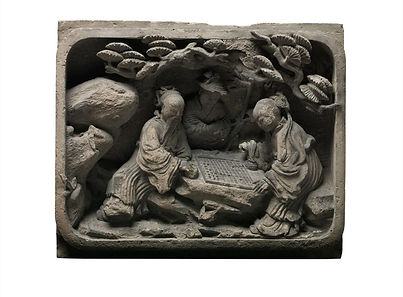
Watching Chess Until the Axe Handle Rots
Period
Mid-to-Late Qing Dynasty
Structure
Doudu (pocket panel)
Dimensions
40.5 cm × 29 cm × 7 cm
Image Source
Photographed on-site at the museum
Description
The pine tree, "the leader of a hundred woods," has a thousand-year-old green pine with twisted branches. Beneath the branches, two immortals play chess while sitting on rocks (with a few bamboo shoots growing on the rocks). A woodcutter places his tools beside the tree, stands with folded hands between the two immortals, and watches the game intently. "It flourishes not in spring, nor withers in winter; clouds come and go as if they were nothing"—a perfect landscape and figure painting. The work skillfully uses openwork and round carving techniques, with a compact and reasonable composition.
This piece is a masterpiece: beneath the pine and beside strange rocks, two immortals play chess—one sits on a stone seat (wearing a square scarf, with a crane-like face and childlike complexion), resting one hand on the stone table and dropping a chess piece with the other, feet propped up in a calm posture; the other immortal sits opposite, reaching into the chess container with a thoughtful smile, his square scarf fluttering in the mountain breeze—their expressions are vividly portrayed. Chen Weide (wearing a straw hat, with a hatchet at his waist) leans casually, twisting his body to watch the game, propping himself up with a shoulder pole (with ropes and hooks wrapped around it). The panel has raised beveled corners, and shallow relief depicts pavilions and cliffs—immortal energy lingers, creating a strong spatial contrast with the round and deep relief of the figures.

Carp Transforms into Dragon
Period
Mid-to-Late Qing Dynasty
Structure
Fang (partial beam panel)
Dimensions
25 cm × 21 cm × 8 cm
63.5 cm × 21 cm × 9 cm
66 cm × 21 cm × 9 cm
Image Source
Photographed on-site at the museum
Description
The Dragon Gate opens wide: an auspicious beast (decorated with baoxiang flowers) emerges dynamically and powerfully from the waves, with ripples around its legs; it pauses, looking back at the auspicious clouds in the sky (the clouds are elegant and well-spaced). A bright moon rises from the clouds, vivid and majestic. A large fish swings its tail, breaking through the waves to leap toward the clouds; to the right, a giant fish (already taking dragon form) flaps its fins, preparing to leap. The wave patterns at the bottom are arranged in an orderly and flexible layout, with distinct layers and dynamic, undulating waves. These three deep relief panels can be appreciated either as a whole or individually.
The carp is a symbol of good fortune in China (e.g., folk New Year paintings feature "Surplus Year After Year," "Good Fortune and Surplus," "Carp Leaps Over the Dragon Gate"), embodying people’s hopes for the future. This carving uses a long-scroll composition with relief and openwork decoration, depicting divine creatures like fish and dragons—it has profound symbolism, echoing the water culture of the Taihu Lake region and the Suzhou literati’s aspiration for official success through studying.

Qilin Gazes at the Moon
Period
Mid-to-Late Qing Dynasty
Structure
Doudu (pocket panel)
Dimensions
31 cm × 29 cm × 10 cm
Image Source
Photographed on-site at the museum
Description
The qilin is called an "auspicious and benevolent beast," combining the body of a deer, tail of a cow, hooves of a horse, and scales of a fish—it perfectly embodies the concept of divine beasts in Chinese culture. In the Qing Dynasty, the qilin was the insignia on the mandarin square of first-rank military officials, indicating its status second only to the dragon. The qilin has a solemn form: powerful but not fierce, dignified but not arrogant, intelligent but not dull—embodying the spirit of self-improvement and gentle approachability. Thus, "Qilin Gazes at the Moon" is a common carving motif, symbolizing peace under heaven.
In the carving, the qilin (covered in flame patterns) stands on a rock, hind legs half-bent, looking up at the moon; the cliff is jagged with rocks and growing plants, and auspicious clouds surround the moon. On the right, an ancient plum tree with sprawling branches blooms proudly. The carving technique is sharp, using extensive openwork to create dense, compact details—the qilin’s scales rise and fall, its mane is as fine as silk, and its expression is subtle and lifelike.

Overjoyed
Period
Mid-to-Late Qing Dynasty
Structure
Doudu (pocket panel)
Dimensions
39.5 cm × 30 cm × 10.5 cm
Image Source
Photographed on-site at the museum
Description
In traditional Chinese folk patterns, a badger and a magpie looking at each other (one above, one below a plum tree) is called "Overjoyed" (Huan Tian Xi Di). The magpie is an auspicious bird; "badger" (huan) is a homophone for "joy" (huan), so the two together symbolize "great joy." Since deer are more recognizable, they are often used instead of badgers in carvings.
Within a beveled frame, a plum tree grows from a rock (to the right), with lush branches and large blooms; a magpie perches on the branches, while a male and female deer emerge from the rocks below, standing on a cliff. A few slender bamboo stalks (bright green) are included— the carving uses contrast between empty and solid spaces, containing rich imagery and artistic connotations.

Prosperity and Longevity
Period
Mid-to-Late Qing Dynasty
Structure
Doudu (pocket panel)
Dimensions
Left panel: 49 cm × 35 cm × 12 cm
Right panel: 49 cm × 35 cm × 12 cm
Image Source
Photographed on-site at the museum
Description
This set of brick carvings is a rare representative of high relief among fine works—the gold brick material reaches a rare thickness of 12 cm.
The four corners have beveled edges; the background plane is treated with oval surfaces at the edges; the petals and leaves are raised in relief, appearing lifelike.

Hehe Immortals
Period
Mid-to-Late Qing Dynasty
Structure
Doudu (pocket panel)
Dimensions
42 cm × 35 cm × 9 cm
Image Source
Photographed on-site at the museum
Description
The "Hehe Immortals" are classic symbolic figures in traditional Chinese culture, representing "domestic harmony and marital bliss," and are symbols of "harmony culture."

Longevity Character Pattern
Period
Mid-to-Late Qing Dynasty
Structure
Doudu (pocket panel)
Dimensions
36.5 cm × 39 cm × 5 cm
Image Source
Photographed on-site at the museum
Description
Longevity culture permeates every aspect of Chinese society. In folk tradition, elderly people’s birthdays are called "longevity celebrations": 60th birthday is the "Flower and Armor Longevity," 70th is the "Ancient Rare Longevity," 80th–90th are the "Octogenarian–Nonagenarian Longevity," and 100th is the "Centenarian Longevity." Folk art motifs like "Magu Presents Peaches," "Pine and Cypress Evergreen," "Turtle and Crane for Longevity," and "Full Hall of Blessings and Longevity" all symbolize auspicious longevity.
The character "Shou" (longevity) appears in various decorative forms in patterns: this work has a beveled frame with decorative lines on all four sides; the "Shou" character is a stylized floral form, mainly carved in relief, combining variant guai zi patterns with vase patterns and bead patterns—creating an auspicious atmosphere.

Censer-Vase Set
Period
Mid-to-Late Qing Dynasty
Structure
Doudu (pocket panel)
Dimensions
36 cm × 31 cm × 8 cm
Image Source
Photographed on-site at the museum
Description
The Three Utensils of the Incense Burner refer to the incense-burning tools in ancient Chinese incense culture. After the invention of the fireproof incense burner in the Song Dynasty, the chopstick bottle (with incense chopsticks and incense spoons inserted), the incense box and the incense burner emerged, collectively known as the Three Utensils of the Incense Burner. The incense smoke rises gently from the burner, filling the air with a pleasant fragrance. This scene is a true portrayal of the life of ancient scholars.
The picture has a double-layered frame with a recessed corner on each side. In the middle of the study is a Ming-style flat-topped table with a knife-toothed apron and a tenon joint with a base. The legs of the table are framed with a curved opening on the side, carved with cloud-head patterns. On the table are the Three Utensils of the Incense Burner. A pair of lamps and lamp stands are placed on either side of the flat-topped table. The picture has a strong sense of perspective, and the spatial sense of the study is well presented.

Stone Bridge in Spring Flood
Period
Mid-to-Late Qing Dynasty
Structure
Doudu (pocket panel)
Dimensions
47 cm × 35 cm × 8.5 cm
Image Source
Photographed on-site at the museum
Description
Whether as background decoration or the main subject, landscape sketches are an important content of Su-style brick carvings in the Ming and Qing Dynasties.
The entire scene uses a panoramic composition, mainly in shallow relief: on the right end, a square pavilion is hidden behind layered rockeries; behind the pavilion, an old pine tree is lush and full. A wooden bridge spans the water, slightly arched, with vines winding around it and railings carved with fish-shaped openings; water flows gurgling beneath the bridge. An ancient willow tree stands tall beside the bridge, its branches swaying as if "blown by the wind." The pavilion is the focal point: though small, it has a complete structure (eaves, pendants, columns), with details that accurately replicate real architecture. The foreground and background are skillfully handled, creating a sense of depth within a small space to enhance perspective and three-dimensionality.
"Strolling in the spring breeze at dawn; clouds and mist over the stream stir emotions." The carving depicts a spring landscape: a small flat bridge, with vines winding in shallow relief on the bridge and flowing water carved in line below; green pines and willows stand on both banks. The willow has an ancient charm, with spider lilies climbing its roots (in full bloom). The pine stands tall and open; a house sits by the water, a pavilion beside the pine (with blue bricks, black tiles, and upturned eaves), and incense utensils displayed inside. In the distance, the lake stretches boundlessly.
Character Category

Shi Jian Ke Jiu (Uphold Frugality to Endure)
Calligrapher
Pan Shien
Period
Daoguang Reign, Qing Dynasty
Structure
Inscription Panel
Dimensions
155 cm × 28 cm × 3.5 cm
Image Source
Photographed on-site at the museum
Description
Diligence and frugality are virtues. The Tang Dynasty poet Li Shangyin wrote in Ode to History: "Looking at the past, for states and families, success comes from diligence and frugality, while ruin comes from extravagance."
Pan Shien (1769–1854) was a native of Wuxian, Jiangsu (now Suzhou), styled Huaitang, Huaiting, and art-named Zhixuan. He became the top scholar (zhuangyuan) in the 58th year of the Qianlong Reign (1793), appointed as a compiler. Later, he served as Minister of Rites, Works, and Personnel. When Emperor Xianfeng ascended the throne, he issued an edict to recruit talents; at the age of 80, Pan Shien recommended Lin Zexu to go to Guangdong to ban opium, advocating that "strengthening internal governance is the only way to resist foreign aggression."
A Suzhou folk saying goes: "The two Pan families of Suzhou occupy half the city." There were the "Wealthy Pan" (rich beyond compare) and the "Noble Pan" (extremely prestigious). In the 34th year of the Qianlong Reign, Pan Yijun (the fifth generation of the Pan family) became the first Jinshi (imperial scholar) of the family, opening the path to officialdom and laying the foundation for the "Noble Pan." The most influential member of the Pan family was Pan Shien—who became top scholar in the 58th year of the Qianlong Reign, known as "the most fortunate person in 300 years." His grandson Pan Zuyin was the second influential figure: he became the third-place scholar (tanhua) in the 2nd year of the Xianfeng Reign, rising to Grand Councillor, Minister of Justice, and Minister of Works, holding great power.
From the mid-Qianlong Reign to the late Guangxu Reign (120 years), the Pan family produced 8 Jinshi (including 1 zhuangyuan and 2 tanhua). Three members served as Ministers or Vice Ministers (second rank or above), and one as Provincial Governor. Almost all prominent scholar-official families in the Jiangnan region had close ties to the Pan family. Two national treasures—the Western Zhou Dayu Ding (collected by the National Museum of China) and Dake Ding (collected by the Shanghai Museum)—were donated by descendants of the "Noble Pan" family.
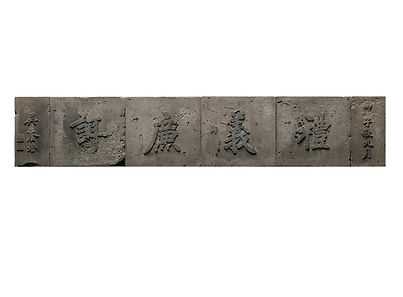
Li Yi Lian Chi (Propriety, Righteousness, Integrity, and Shame)
Calligrapher
Wu Yinpei
Period
Guangxu Reign, Qing Dynasty
Structure
Inscription Panel
Dimensions
150.5 cm × 28 cm × 3 cm
Image Source
Photographed on-site at the museum
Description
"The state has four pillars: if one pillar breaks, the state tilts; if two break, it is in danger; if three break, it collapses; if four break, it perishes. ... What are the four pillars? First: Propriety; second: Righteousness; third: Integrity; fourth: Shame." — Guanzi · Herding the People (Spring and Autumn Period).
Ancient people believed: Propriety defines hierarchy; Righteousness guides action; Integrity means being honest and upright; Shame means having a sense of moral responsibility. The History of the Five Dynasties · Biography of Feng Dao states: "Propriety, Righteousness, Integrity, and Shame are the four pillars of the state; if the pillars do not stand, the state will perish."
Wu Yinpei (1851–1930) was styled Shubai, art-named Yingzhi, Yun’an, and "Pingjiang Hermit." A native of Wuxian, Suzhou, he became the third-place scholar (tanhua) in the 16th year of the Guangxu Reign (1890). He was renowned alongside Zhang Yilin, Fei Shuwei, and Li Genyuan, and enjoyed befriending artists. In the early Republic of China, he founded the "Wuzhong Tomb Protection Society." In the 5th year of the Republic of China, he served as one of the chief compilers of Gazetteer of Wu County, compiling local records of Suzhou. In his later years, he devoted himself to textual research and lived in seclusion in the city.
The inscription is carved in raised relief on six square bricks, in regular script. The upper inscription reads: "September of the Jiazi year"; the lower inscription reads: "Wu Yinpei."

Gui Zhi (Cassia Ganoderma)
Calligrapher
Lu Chengdong
Period
Guangxu Reign, Qing Dynasty
Structure
Inscription Panel
Dimensions
83.5 cm × 27.5 cm × 7 cm
Image Source
Photographed on-site at the museum
Description
The "Hehe Immortals" are classic symbolic figures in traditional Chinese culture, representing "domestic harmony and marital bliss," and are symbols of "harmony culture."

Qing Hui (Clear Radiance)
Period
Mid-to-Late Qing Dynasty
Structure
Scroll-shaped Inscription Panel
Dimensions
52 cm × 24 cm × 5.5 cm
Image Source
Photographed on-site at the museum
Description
"Qing Hui" means "bright, pure radiance." Ruan Ji of the Wei Dynasty wrote in Lyric Poems (No. 14): "A gentle breeze blows the silk sleeves; the bright moon shines with clear radiance." Xie Lingyun of the Jin Dynasty wrote in Returning to the Lake from the Stone Chamber Hermitage: "Morning and evening bring changes in weather; mountains and waters hold clear radiance."
The panel is shaped like a scroll, with scroll ends carved integrally on the left and right. The text ("Qing Hui") is carved in raised relief (sunken background) in regular script, decorated with lacquer filled with fine coal essence stone. The writing is elegant and the carving is smooth. This panel was likely used in a cave dwelling or gate scene.

Hehe Immortals
Calligrapher
Chen Zhonglin
Period
Jiaqing Reign, Qing Dynasty
Structure
Inscription Panel
Dimensions
73 cm × 24.5 cm × 3 cm
Image Source
Photographed on-site at the museum
Description
"The jade resonates, the metal rings; the orchid fragrance and cassia aroma spread" comes from Fifteen Poems for the Empress Dowager’s Temple: For the Hall of Yuan De (court songs of the Song Dynasty). "Lan Fen" (orchid fragrance) metaphorically refers to virtues and favors that endure over time; traditionally, it means "descendants achieving prominence simultaneously."
The upper inscription reads: "Mid-summer of the Xinwei year, Jiaqing Reign" (with a red seal); the lower inscription reads: "Chen Zhonglin, style name Houfu" (with a red seal "Houfu" and a white seal).
Chen Zhonglin (1763–1840) was styled Zhaojia, art-named Houfu, a native of Suzhou. A Qing Dynasty scholar and opera writer, he became a provincial exam top scorer (jingkui) in the Jia Yin year of the Qianlong Reign, and a Jinshi (imperial scholar) in the Ji Wei year of the Jiaqing Reign.
The panel consists of two square bricks; the text is carved in raised relief (sunken background) in cursive script.

The Book of Songs · Minor Odes · Si Gan
Period
Mid-to-Late Qing Dynasty
Structure
Doudu (pocket panel)
Dimensions
42 cm × 35.5 cm × 8.5 cm
Image Source
Photographed on-site at the museum
Description
The lines are from The Book of Songs · Minor Odes · Si Gan: "Clear flows the stream; deep and quiet the southern mountain. Like bamboo shoots clustering, like pines flourishing. Brothers are here, living in harmony, no deceit between them. Continuing the line of ancestors, building a hundred walls, doors opening to the southwest. Living here, dwelling here, laughing here, talking here."
This inscription quotes The Book of Songs to promote the legacy of ancestors and express the hope for family harmony: "To carry forward the legacy of our ancestors, we prepare to build a grand mansion, opening large doors on the southwest side of the palace. The whole family lives together in harmony, laughing and talking every day—envied by the world!"
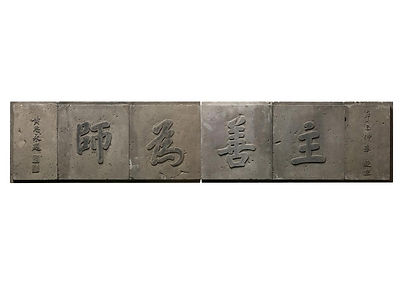
Zhu Shan Wei Shi (Take Goodness as the Teacher)
Calligrapher
Huang Siyong
Period
Tongzhi Reign, Qing Dynasty
Structure
Inscription Panel
Dimensions
151 cm × 32 cm × 5.5 cm
Image Source
Photographed on-site at the museum
Description
Huang Siyong (1842–1914) was a native of Jiangning (now Nanjing). He became the top scholar (zhuangyuan) in the 6th year of the Guangxu Reign (1880).
In the 29th year of the Guangxu Reign, the Qing government established the Ministry of Commerce; Huang Siyong was hired as a first-class advisor by Minister Zai Zhen, and was called "the two top scholars of the Ministry of Commerce and Industry" (along with Zhang Jian). He was also the first person in China to initiate bond and stock issuance.
The phrase "Virtue has no constant teacher; take goodness as the teacher" comes from The Book of Documents · Xian You Yi De, meaning: "Virtue has no fixed role model; one should take doing good as the standard."

Xi Er Chun Gu (Bestow Great Blessings Upon You)
Calligrapher
Jin Zao
Period
Tongzhi Reign, Qing Dynasty
Structure
Inscription Panel
Dimensions
118 cm × 28 cm × 3.2 cm
Image Source
Photographed on-site at the museum
Description
The upper inscription reads: "Mid-summer of the Guiyou year, Tongzhi Reign, auspicious day"; the lower inscription reads: "Jin Zao, style name Xingsheng."
"Xi Er Chun Gu" comes from The Book of Songs · Minor Odes · The First Feast of Guests: "Xi Er Chun Gu, may your descendants be happy." The character "Xi" is a phonetic loan for "ci" (bestow); "chun gu" means "great blessings."
The text is carved in raised relief (sunken background) in clerical script—with a strict structure, solemn and simple style. The panel has a finely carved key-pattern border.

Lan Yu Jiao Hui (Orchid and Jade Shine Together)
Calligrapher
Tan Bangxian
Period
Daoguang Reign, Qing Dynasty
Structure
Inscription Panel
Dimensions
155 cm × 28 cm × 3.5 cm
Image Source
Photographed on-site at the museum
Description
The orchid is a fragrant herb. The Confucian Analects · In Distress states: "The orchid grows in the deep forest; it is fragrant even when no one is around; a gentleman cultivates his moral character and does not change his principles even in poverty." In ancient times, the orchid always represented the virtues of a gentleman. Fine jade has also long been a symbol of the "gentleman" in Chinese culture: jade has five virtues—"moist and warm (benevolence); its texture reveals inner quality (righteousness); its sound spreads far (wisdom); it does not bend before breaking (courage); sharp but not harmful (purity)."
"Lan Yu Jiao Hui" implies that one should conduct oneself with the demeanor of a gentleman, embodying the qualities of the orchid and jade. The carving technique of these four characters is essentially the same as that of the inscribed text on the back of a Southern Song brick-carved Ruyi Immortal Plaque: the edges of the shallowly carved regular script (e.g., "If the stone rots, someone will replace it") are outlined in double lines, and the center of the text is raised into a rounded surface.
Tan Bangxian was a native of Wuxian, Qing Dynasty, and a tribute student (gongsheng). The text is carved in double-line outline (sunken), with the upper and lower inscriptions in raised relief: the upper inscription reads "Spring month of the Yiwei year, Daoguang Reign"; the lower inscription reads "Tan Bangxian, style name Xianggu." The script is cursive—elegant, free, and with a lofty artistic conception.

Cao Man (Play the Zither)
Period
Daoguang Reign, Qing Dynasty
Structure
Scroll-shaped Inscription Panel
Dimensions
57 cm × 24 cm × 10 cm
Image Source
Photographed on-site at the museum
Description
"Cao Man" means to play the qin (zither). The qin was the most esteemed musical instrument in ancient Chinese culture—there is a saying: "A scholar does not remove his qin or se (lute) without reason," and "qin on the left, books on the right." It ranks first among the "Four Arts" (qin, chess, calligraphy, painting) and is regarded as a symbol of elegance by literati.
The panel is scroll-shaped; the text is carved in raised relief (sunken background) in cursive script—alternating between thick and thin strokes, with a slow, deliberate style.
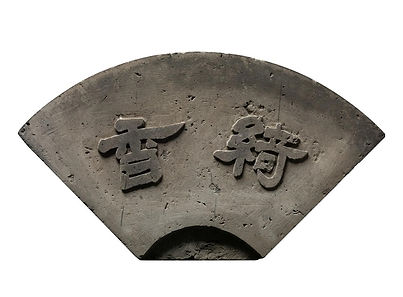
Qi Xiang (Gorgeous Fragrance)
Period
Mid-to-Late Qing Dynasty
Structure
Inscription Panel
Dimensions
58.5 cm × 33.5 cm × 4 cm
Image Source
Photographed on-site at the museum
Description
"Qi" refers to fine silk fabric with patterns, meaning "gorgeous, beautiful, exquisite." "Qi Xiang" means "beautiful and fragrant." This panel was intended for use in a courtyard: Suzhou gardens have flowers and plants for every season, and "Qi Xiang" often describes a beautiful, seasonally appropriate scene.
The panel is fan-shaped, with a balanced open-close form; the text is carved in raised relief (sunken background) in clerical script.

Ken Gou Ken Tang, Aspiring to Honor Ancestors and Secure Descendants; Ke Qin Ke Jian, Resolving to Continue the Legacy and Build Great Undertakings
Period
Mid-to-Late Qing Dynasty
Structure
Doudu (pocket panel)
Dimensions
Left panel: 42 cm × 30.5 cm × 6 cm
Right panel: 42 cm × 30.5 cm × 6 cm
Image Source
Photographed on-site at the museum
Description
Both pocket panels have raised lines on all four sides and corner decorations. The center of one rounded panel is shallowly carved with: "Ken Gou Ken Tang, Aspiring to Honor Ancestors and Secure Descendants," signed "Lan Pu" (with two name seals: "Chen Heng" and "Lan Pu"); the other panel is shallowly carved with: "Ke Qin Ke Jian, Resolving to Continue the Legacy and Build Great Undertakings," with an occasional seal "Apricot Blossoms in Spring Rain" and dated "Mid-autumn of the Yimao year." Based on the brick material, it was carved in the mid-Qing Dynasty.
"Ken Gou Ken Tang" comes from The Book of Documents · Da Gao: originally meaning "a son who refuses to lay the foundation of a house will not build it"; later used ironically to mean "a son can inherit his father’s career." "Hong You" means "great undertaking."
"Ke Qin Ke Jian" comes from The Book of Documents · Dayu Mo: "Diligent in serving the state, thrifty in managing the family"—meaning "both hardworking and thrifty."
The "Apricot Blossoms in Spring Rain" seal is an implied seal, referring to the allusion of passing the imperial exam and visiting the apricot garden (a tradition for top scholars).