
Sotheby's
Art History
Offline courses
2025-07
Dr. Patrizia Costa, professor at the art history course of Sotheby's Summer History Camp, provided my course evalution as follows:
“Lucas’ enthusiasm for both history and art of all sorts was readily apparent and a delight to witness. He eagerly offered up personal insights on Chinese characters and political dynasties, broadening and enriching class conversations. His intelligence and passion shone through all his assignments, and he submitted all work in a timely manner. He sought clarity during lectures by asking thoughtful questions, engaged in conversations about art with faculty and classmates during site visits and was always highly attentive. Lucas was a phenomenal addition to our Art History class.
Lucas demonstrated a strong socio-political approach to art history and was eager to hone his skills in other methodologies as well, including connoisseurship. His reflection essays on the workshop practices of Italian Renaissance Artists, a review of an academic paper on female figures in Buddhist art and his visit to the newly remodeled Frick Museum were particularly strong and insightful. His comments on narrative history, patronage, and critical approaches were original and the product of a willingness to contribute to conversations in the general scholarship in meaningful ways rather than simply listening in. Our conversations on these topics continued also after class on and on our walks to our afternoon museum visits.“
標題 2
Helvetica Light is an easy-to-read font, with tall and narrow letters, that works well on almost every site.
Vision and Cultivation
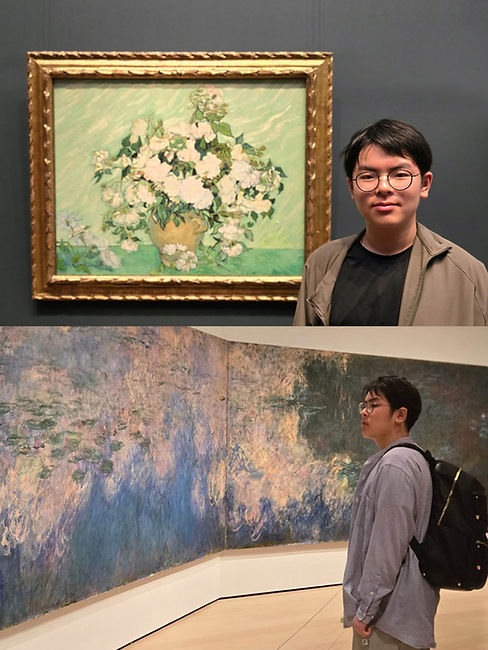
I have a strong passion for art. At the Sotheby's Summer School, I studied art history from a global perspective, deepened my understanding of art, and gradually developed cross-cultural art appreciation skills. Art history encompasses various culture. Visiting world-class art museums allowed me to deeply understand these cultures, piecing together the historical logic underlying these real-life artworks. This summer course also collaborated with Columbia University, presenting us with 1st-century Mediterranean artifacts, which reinforced my view of artworks as a gateway to history.
The Concord Review
History
Offline courses
2025-08

Academic Training & Writing Practice
This summer I participated in the TCR summer program, where I received systematic training in academic writing under the professor's guidance—covering literature retrieval, material organization, and analytical framework construction. The professor paid meticulous attention to the finer details of essay writing, offering in-depth demonstrations and constructive feedback on everything from argumentative logic to stylistic expression. Over six months of painstaking effort, I completed a 13,232-word paper and submitted it to TCR. The entire process gave me a much sharper understanding of scholarly rigor and strengthened my ability to conduct independent research.

Iowa
Creative Writing
Online courses
2025-06
Ideas and Expressions
The Iowa writing course has cultivated my acute perception, enabling me to notice the fleeting yet interesting details in life. These seemingly trivial fragments, guided by the course instructor, are connected with the ordinary yet authentic things in life, ultimately elaborating on larger and more comprehensive concepts.
After attending this course, my writing became more explicit and accessible. Gradually, I learned to use simple and genuine words to trigger readers' empathy. As the reading progresses, readers can gradually enter my inner world and accurately receive the information I intend to convey, encouraging their thoughts and reflections on my topics of discussion.
Pioneer
Art History
Online courses
2026-02
Pioneer
Art History
Online courses
2026-02
Research & Writing
This course centered on a research paper on Hōryū-ji and Tōdai-ji in Japan, approaching them from the perspective of architectural art history. I consulted a wide range of primary sources and went through multiple rounds of revision under the professor's guidance. Every step—from organizing materials to shaping arguments—involved systematic scrutiny and refinement. The final paper exceeded 9,500 words, and I am satisfied with the outcome. This training also deepened my understanding of East Asian architectural traditions.
Reflection
This summer I took an online course at The Courtauld Institute of Art, Renaissance Art at the Crossroads: Italy and the Netherlands. Working through close visual analysis and cross-regional comparison, I came to see how space, materials, and pictorial logic operated differently—and sometimes met—between the two traditions. The pace was intensive but absorbing. It also pushed me to slow down in my own way of looking, whether in museums or in the field.
The Courtauld Institute of Art
Renaissance Art at the Crossroads: Italy and the Netherlands
Online courses
2026-06


The Courtauld Institute of Art
Nature, Gender, Form: New Approaches to the Pre-Raphaelites, the Aesthetic Movement, and Arts & Crafts
Online courses
2026-06
Reflection
This summer I completed an online course offered by The Courtauld Institute of Art, focusing on the artistic exchange between Renaissance Italy and the Netherlands. Through high-resolution image analysis and comparative regional study, the course trained me to examine composition, materiality, and spatial logic more systematically. Viewing works on screen demanded a slower, more deliberate mode of attention than museum visits typically allow. The structured content also encouraged me to apply similar observational discipline to my own fieldwork on architecture and urban spaces.
Reflection
In July I took an online course at UChicago on Italian Renaissance art, tracing the shift from early experimentation to High Renaissance order. The lectures broke down materials, patronage, and spatial logic in a way that connected dots I had missed in museums. After class, I spoke privately with the professor about cultural exchange between East and West, touching on how visual traditions in China, Japan, and Europe developed within their own historical contexts. Rather than offering simple conclusions, she encouraged me to consider how each civilization shaped its own way of seeing.
UChicago
Introduction to the Arts of the Italian Renaissance
Online courses
2026-07
